
Deutsche Version: Hyperrealismus, Fotorealismus, Realismus: der Unterschied einfach erklärt
“Is that a photo?” is the question people ask most in front of Lena Krashevka’s paintings of faces behind rain on glass. The answer is no: it is oil paint, applied by hand. But which word describes it? Photorealism, hyperrealism and contemporary realism are often used as if they meant the same. They do not. Here is the difference in plain words.
Photorealism began in the United States in the late 1960s, after Pop Art. The New York gallerist Louis K. Meisel gave it its name. Painters such as Richard Estes, Chuck Close, Audrey Flack and Ralph Goings took photographs, often their own, and transferred them to canvas as exactly as possible, including the things a camera does: reflections, depth of field, the flat light of a snapshot.
The subject of photorealism is, in a way, the photograph itself. Shop windows, cars, diners and portraits are painted the way a lens records them, cool and without comment.
Hyperrealism grew out of photorealism from the 1970s on and became the broader term. It covers painting and sculpture, from Duane Hanson’s life-size figures to today’s painters. The difference: hyperrealists do not stop at what the camera shows. They sharpen pores, drops and textures beyond what any lens resolves, and they use that intensity to tell a story or create an emotion.
A simple test: a photorealist painting looks like a good photograph. A hyperrealist painting looks like a photograph from far away, and clearly like something more when you step closer.
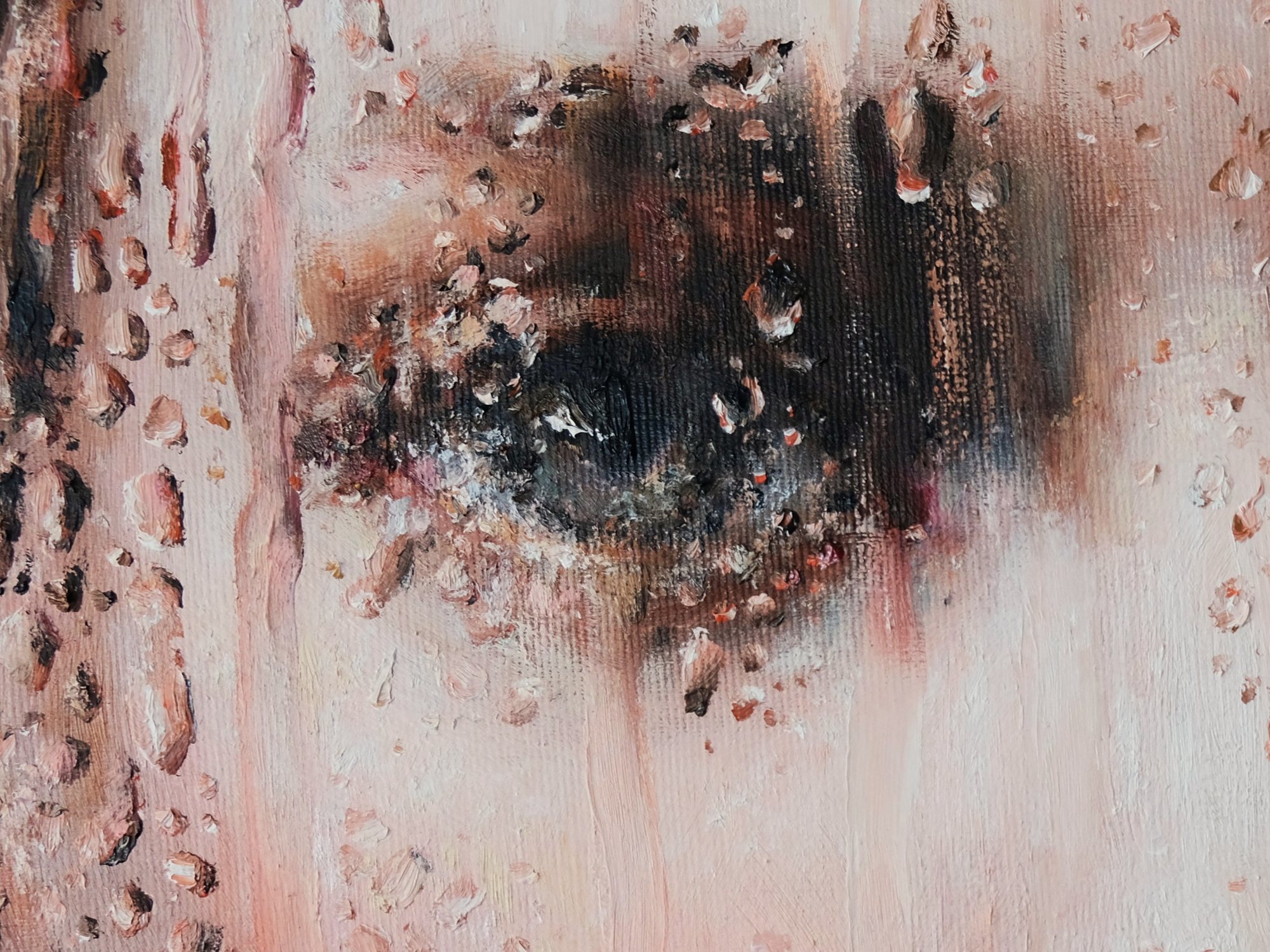
Contemporary realism is the widest of the three terms. It describes realist painting today, which is not necessarily photo-like. It can be precise in one place and loose in another, combine realism with abstraction, or use a realistic surface as a metaphor. What counts is not how exactly the world is copied, but what the realism is for.
Gerhard Richter showed early on how much meaning can lie in the gap between photo and painting: from the 1960s he painted from photographs and deliberately blurred them.
Lena calls herself a contemporary realist painter. Her techniques are hyperrealist: water drops on glass that seem to stand out from the canvas, bubble wrap you want to press. But the precision serves an idea. In the Reflection series the face behind the glass is blurred and the drops are sharp, the opposite of what a camera would focus on. The glass stands for the distance between us and our own feelings.
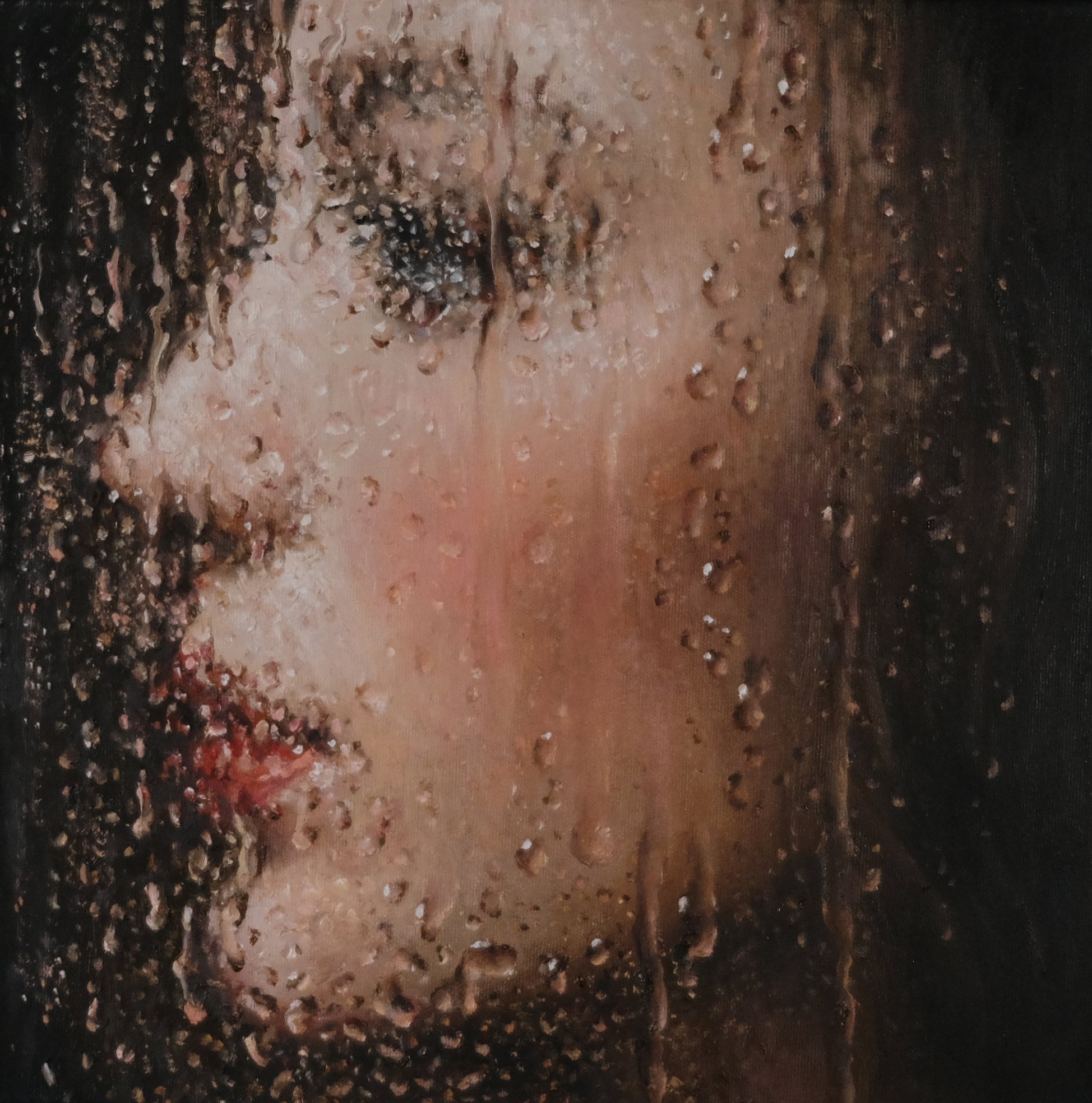
Sharp drops, blurred face. Hyperrealist technique, used for a contemporary idea: how hard it is to see ourselves clearly.
Reflection #55, 40×40 cm, oil on canvas, 2026, €2,400
In the Isolation series, painted during the years of lockdowns, faces appear behind plastic film. The film both protects and separates.

Only bubble wrap, painted in oil. Every bubble with its own reflection.
Isolation #002, 30×30 cm, oil on canvas, 2022, €1,800
Why this matters more than ever: in the age of AI, many images only look painted. Why the human hand counts: Made by hand.
Realist painting takes time: many thin layers, each drop and each bubble by hand. That is reflected in the price, which at Lena’s studio follows the size: how prices work. See the available Reflection paintings or all available works, and in Cologne see them in the studio.