
Deutsche Version: Von Hand gemalt: Warum Originalgemälde im Zeitalter der KI mehr zählen
Type “a woman’s face behind a window covered in rain” into an image generator and a few seconds later you have a picture. Several, if you like. They will look convincing at first glance, and you can make a thousand more before your coffee gets cold.
Lena Krashevka paints the same subject by hand. One drop at a time, in thin layers of oil, over many sessions in her studio in Cologne, until the water on the glass looks wet enough to touch. The result is one painting. There will never be a second one exactly like it.
It would be easy to think that the first way makes the second one obsolete. The opposite is happening. The more images machines produce, the more people value the ones a person actually made, and the more they want to know who made them, how and why.
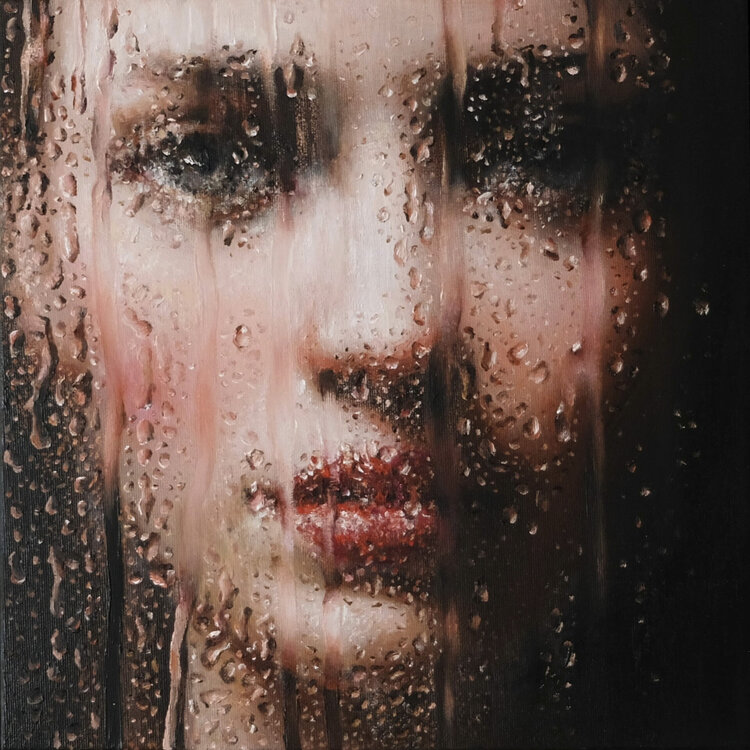
Every drop in this painting was a decision: where the glass stays sharp, where the face dissolves, where the eye of the viewer should land first. That is the difference between an image that is generated and one that is made.
Reflection #49, 40×40 cm, oil on canvas, 2026, €2,400
On 2 October 2026, Pope Leo XIV spoke to artists and curators in Rome. His message was unusually direct about technology. “This is especially true in this age of artificial intelligence,” he said, “in which we urgently need to distinguish human art from what is produced by machines.”
He went further than taste. There is, in his words, “an ontological difference … between art and what a machine can generate through statistical calculation based on millions of images created by others.” Algorithms, he said, “lack the spark of the human.”
One image from the speech stays with you. We live, the Pope said, in the age of search engines that return what already exists and tend to give us what we already want. “Art is a different kind of ‘search engine.’ It does not proceed by indexing but by inquiry.” Art, in other words, does not average what is already out there. It looks for something that is not there yet. (Full text on vatican.va)
From a very different direction, Bill Gates has made a similar point. Asked about the future of work, he predicted that with AI, humans will not be needed “for most things”. But not for everything: “We won’t want to watch computers play baseball,” he said. “There will be some things we’ll reserve for ourselves.” (Report on tech.co)
In October 2026 he went further. On The Verge’s Decoder podcast he said that, even when machines can do these things better, people may choose to keep some activities in human hands, and he named four: childcare, cooking, sports and art. He compared it to the Amish, who decide for themselves which technology to let in. (Report on the interview)
That is the point of this essay in his words, not ours. When machines can do almost anything, what we choose to keep human becomes a statement about what we value. Art made by a person, with their own hands and their own risk of failure, is on that short list.
Lena’s best-known series, Reflection, shows faces behind glass covered in rain. People who see the paintings online often assume they are photographs. In front of the canvas, the illusion turns into something else: you see layers, edges, the tiny highlights that make a drop look round, and the places where the painter chose to let the face disappear.
Her earlier series Isolation does the same with plastic film: faces pressed behind bubble wrap, painted in the years of lockdowns, when many people felt exactly that. A machine can reproduce the look of bubble wrap. It cannot have lived through those years and decided that this was the right image for them.

In the Isolation series the plastic is both subject and metaphor: something that protects and suffocates at the same time.
Isolation #13, 30×30 cm, oil on canvas, 2022, €1,800
This is what the Pope means by inquiry rather than indexing. A generator gives you the most probable version of a prompt. A painter keeps asking: what does this face need, what should stay hidden, when is it finished? The answers are in the painting, and you can feel them even if you can’t name them.
None of this is a promise about prices or returns. Art is worth buying because you want to live with it. But it is worth knowing that, in the age of AI, the human hand is not becoming less important. It is becoming the point.
See the Reflection and Isolation series, browse all works, or read the Christmas gift guide for smaller originals from €930. Questions about a painting? Use the “Acquire This Artwork” button on any work, or write to Lena.